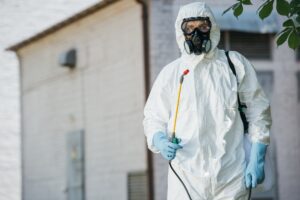
Every spring and summer, Melbourne households find European wasps hanging around the barbecue, the bins or the kids’ drinks. By late summer, nests that started small in spring can be very large and very defensive. Here’s how to tell what you’re dealing with, where to look for the nest and what to do about it safely.
What does a European wasp look like?
European wasps (Vespula germanica) are often mistaken for bees. Look for:
- Bright yellow and black bands with black dots on the abdomen, and less hair than a bee.
- Yellow legs that are tucked up in flight. Paper wasps let their long legs dangle.
- Fast, direct flight straight in and out of the nest entrance, rather than hovering.
- A strong interest in meat, pet food, fallen fruit and sweet drinks.
European wasps aren’t native to Australia. They reached Victoria in the 1970s and, according to Agriculture Victoria, they are now found across most of the state.
European wasps vs paper wasps vs bees
| European wasp | Paper wasp | Honey bee | |
|---|---|---|---|
| Nest | Hidden: in the ground or in wall/roof cavities | Open, umbrella-shaped, under eaves and on fences | Hives, tree hollows, wall cavities, swarms |
| Stings | Can sting repeatedly | Can sting repeatedly | Usually stings once |
| Attracted to | Meat, pet food, sweet drinks, bins | Garden insects | Flowers |
Honey bees are important pollinators. If you have a bee swarm, it will often move on by itself within a day or two. If bees have moved into a wall or roof, call us and we’ll advise on the best option.
Where European wasps build their nests
Most European wasp nests are underground or close to ground level, which is why people often only find them after someone is stung. Check:
- Holes in lawns and garden beds, especially with wasps flying in and out
- Rockeries, retaining walls and sleepers
- Around the base of trees and in old stumps
- Unused compost heaps and woodpiles
- Subfloors, wall cavities and roof spaces, often through a small gap or weep hole
Inside, a nest is a grey, papery ball. The only thing you’ll usually see from outside is a single small entrance with a steady stream of wasps. European wasps can forage up to about half a kilometre from the nest, so seeing wasps at your bins doesn’t always mean the nest is on your property. Watch where they fly: a constant line of wasps heading to the same spot is the giveaway.
Why you shouldn’t remove a European wasp nest yourself
- They defend the nest in numbers. Disturbing the entrance can bring out a large number of wasps, and each one can sting more than once.
- Blocking the hole can push them inside. If the nest is in a wall or ceiling, wasps may chew through plaster and come out into the house.
- Spray cans rarely reach the nest. Surface sprays kill the wasps you can see, not the colony deep in the ground or wall.
- Allergic reactions can be serious. Anyone with a known allergy to stings should stay well away.
We have a longer article on how professionals get rid of wasp nests if you’d like the detail.
Found a wasp nest?
Wasp nest removal starts from $169 including GST. Same-day slots are often available, 7 days.
How we treat a European wasp nest
- Find the nest. We track the flight path to the entrance, whether it’s in the lawn, a retaining wall or a wall cavity.
- Treat the colony. We apply a registered product directly into the nest entrance so it reaches the colony, not just the wasps outside.
- Advise you on safety. Activity usually drops off quickly. We’ll tell you how long to keep people and pets away from the area.
- Prevent the next one. We’ll point out gaps and spots where new queens are likely to nest next season.
See our wasp and bee nest removal service for more details and pricing.
How to keep wasps away from your backyard
- Keep bin lids closed and rinse food scraps out of recycling.
- Don’t leave pet food or meat scraps outside.
- Pick up fallen fruit under fruit trees.
- Cover drinks outdoors and check cans and bottles before you sip.
- Cover compost and seal gaps in walls, eaves and weep holes where you can.
Frequently asked questions
When are European wasps worst in Melbourne?
Nests start in spring and grow through summer, so wasps are usually most noticeable from late summer into autumn, when nests are at their biggest.
What should I do if I’m stung?
Wash the area and apply a cold pack to reduce pain and swelling. Call 000 straight away if the person has trouble breathing, swelling of the face or throat, or any other sign of a severe allergic reaction.
Will a wasp nest go away on its own?
In some cold areas a nest may die off over winter, but in Melbourne’s milder climate nests can survive and keep growing. It’s safer to have it treated.
How much does wasp nest removal cost?
With us, wasp and bee nest removal starts from $169 including GST. Nests that are hard to reach are quoted upfront. See our full Melbourne pest control price guide.
Spiders often follow wasps and other insects around the house. Find out which Melbourne spiders are actually dangerous.